As The Bright Light Social Hour returns to Tampa, Curtis Roush reflects on evolution, improvisation, and creative survival
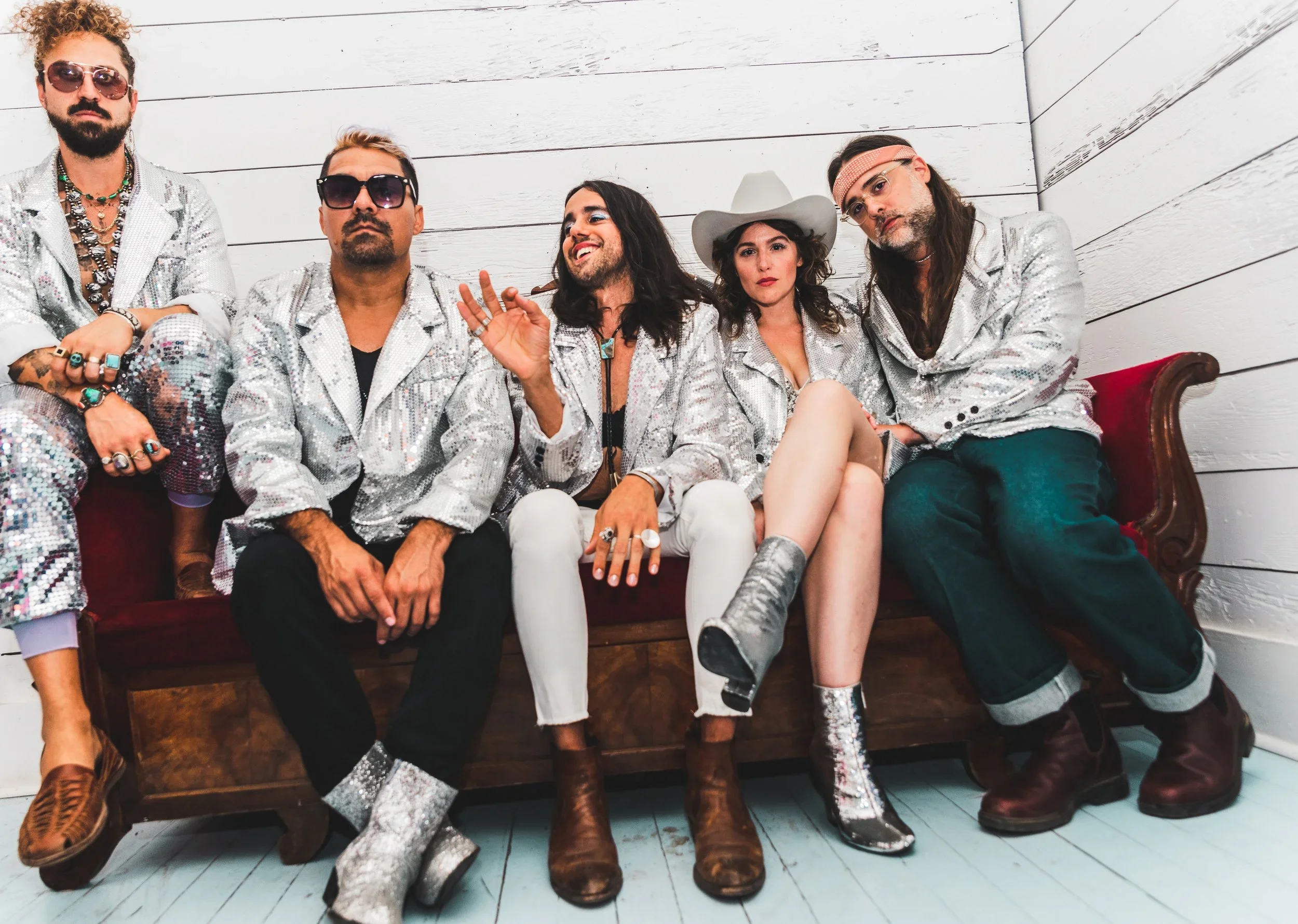
Photo by Andrea Escobar
Ahead of the band’s June Crowbar show, the guitarist and vocalist discusses new projects, cosmic influences, and navigating an industry built on constant motion.
For over fifteen years, The Bright Light Social Hour has existed in a near constant state of movement. Across six studio albums, the Austin band has drifted between indie rock, dance music, and cosmic ambience without ever sounding disconnected from its Texas roots. Songs stretch and reshape themselves, new projects emerge from different corners of the band, and entire musical directions branch outward before eventually circling back together again.
That sense of evolution feels especially fitting ahead of the band’s return to Tampa on Tuesday, June 9, when The Bright Light Social Hour will play Crowbar in Ybor City during one of the venue’s final stretches after 20 years as one of Tampa Bay’s defining independent music spaces. Like Tampa itself, the band seems caught in a conversation about change—how artists evolve creatively, how music scenes survive growth, and how identity manages to persist through all of it.
Speaking with Cigar City Sounds ahead of the show, guitarist and vocalist Curtis Roush repeatedly returned to the idea of expansion rather than reinvention, describing a band that has survived by allowing itself room to branch outward instead of forcing every creative impulse into a single shape.
Recently, Roush and his wife, keyboardist Mia Carruthers, launched Mid America, a project rooted more heavily in folk and Americana traditions, while bassist and vocalist Jackie O’Brien has continued exploring more dance-oriented grooves through Starflake.
“In the band, Jack and I being sort of the primary songwriters—I mean, everyone writes music—but being the primaries over the last 20 years, if our music is just going into Bright Light, we have a tendency to sort of cut off the edges,” Roush said. “Like, sort of my folkier part and his dance music part.”
Rather than fracturing the band’s identity, Roush believes those outside projects have allowed everyone to lean further into what naturally inspires them while preserving what makes The Bright Light Social Hour work in the first place.
“Having these other projects kind of just allows Bright Light to be Bright Light, and Jackie to be Starflake, and Mia and I to be Mid America,” he said. “We can kind of be everything really comfortably, like true to ourselves.”
For Roush and Carruthers, Mid America became an outlet for a shared love of folk and Americana music that never fully sat at the center of Bright Light Social Hour’s sound. O’Brien, meanwhile, has used Starflake to pursue a more rhythmically driven vision.
“Jackie has long dreamt of having a more exclusively dance band, and he’s kind of taking the opportunity to represent the rhythms of his Mexican culture and integrate them with psych rock,” Roush explained. “It kind of makes a new expression for him.”
Still, Roush sees Bright Light Social Hour itself as the place where all of those separate influences ultimately reconnect.
“I think where Bright Light kind of comes together, in the end, is kind of blending the dance, and the rock, and the cosmic, and the Texan, and kind of bringing it all back together,” he said. “But Mid America and Starflake, I think, represent some extensions out in certain genre branches.”
That word, “cosmic”, has followed the band for years, both in their music and in conversations surrounding it. For Roush, the term refers to the atmosphere and ideas running underneath the music.
“To me, I feel like it’s a bit synonymous with psychedelia,” Roush said. “There’s a long tradition of psychedelic music and this aesthetic of space, like a sense of unlimited possibility and mystery and hidden depth.”
Roush points toward influences ranging from German Kosmische Musik pioneers like Can and Neu! to the cosmic country lineage of Texas artists like Doug Sahm and Willie Nelson. The Bright Light Social Hour’s own 2015 album Space Is Still the Place directly references jazz visionary Sun Ra’s landmark Space Is The Place, further tying the band to that lineage of spiritually expansive music.
“The music has an ambience, and a sense of mystery and unknown that inspires Jack and I,” Roush said. “Trying to find where those boundaries can touch is a source of constant motivation.”
That openness has also shaped the band’s relationship with improvisation over the years. After two decades of performing together, Roush describes improvisation as a kind of meditation when on stage.
“I find it really comforting to improvise,” he said. “I enter a really relaxed mental state where I don’t have the kind of anxieties I usually feel in everyday life, and I just feel music moving through me.”
Nearly every Bright Light Social Hour song contains some sort of improvisational element when performed live, even if only a brief 4 bar section. Over time, those spontaneous moments often permanently alter the songs themselves.
“Sometimes the songs dramatically change over the course of years, because there’ll be these very small layers of improv that become kind of new parts,” Roush said. “They started out as improvisations but became part of the composition.”
“You accumulate enough of those over a few years, and you look back to an original recording, and you’re like, ‘wow, this song is much different now.’”
That same sense of reinterpretation extends to how Roush relates to older material personally. When the band released its self-titled debut in 2010, he was 26 years old, living in Austin with friends. Now 42, he lives in Wimberley in the Texas Hill Country surrounded by family. Revisiting songs written during entirely different stages of life requires finding new ways to connect with them honestly.
“For those songs to sort of stay authentic, we have to speak to them freshly,” he said. “Even first album songs, I try to come out with inspiration that I have currently.”
At the same time, the band has continued navigating an industry landscape that increasingly demands constant visibility, rapid content cycles, and short attention spans. Roush acknowledged the pressure many artists feel trying to maintain creative focus while also existing inside the modern attention economy.
“A lot of artists have talked about the collapse of income from the streaming models,” he said. “And also, an extent to which short form video and sharing just a ton of yourself all the time seems like a requirement for the job.”
Still, he says the band has resisted allowing those demands to fundamentally reshape how they think about making music.
“We’re all kind of album people,” Roush said. “We like that full story, it’s the musician’s feature film. It feels like the marquee product or way to express yourself.”
Even while adapting to newer expectations around visibility and content, Bright Light Social Hour continues approaching music as long-form artistic expression rather than isolated singles.
“The industry could say, ‘Hey, release only singles,’ but you can just release your album,” he said. “You can release six singles if you want to. There’s nothing stopping you, so you can still kind of do it your way.”
That mindset seems reflected in the sheer number of projects currently orbiting the band. Alongside Mid America’s debut record and Starflake’s upcoming album, The Bright Light Social Hour has already written more than 15 songs for a new record while simultaneously preparing an expansive live release compiled from last year’s Emergency Leisure tour.
For a band nearly twenty years into its existence, Roush sounds far more energized by expansion than preservation. And in many ways, that same philosophy shapes how he views music communities themselves.
Bright Light Social Hour’s relationship with Tampa dates back to the band’s earliest touring years, when Florida became a regular stop along Gulf Coast routing from Texas. Tampa specifically, became one of the group’s earliest strongholds thanks to support from WMNF, local promoters, and publications like Creative Loafing Tampa.
“Tampa in particular kind of grabbed hold of the band,” Roush said. “The town paid attention and has never let go of us, so we keep coming back.”
That long relationship makes the timing of the band’s return to Crowbar feel especially poignant. Like Tampa in recent years, Austin has spent decades navigating explosive growth and the displacement that often follows it. Independent venues close, creative spaces disappear, and entire neighborhoods begin reshaping around development and commerce.
Still, Roush stops short of viewing those changes entirely through cynicism.
“I don’t think it’s healthy to try to freeze cities in time,” he said. “They have to grow, they have to change, and it’s sort of inevitable in a way.”
Instead, he describes culture as something that continuously relocates and re-forms itself even as older spaces disappear.
“There’s a way that this kind of hippie Texan backyard culture keeps getting pushed around,” Roush said. “Places close down, new growth, new progress comes in its place. But I’ve noticed that it always has a way of cropping back up somewhere else.”
For a band like The Bright Light Social Hour, that outlook feels inseparable from the music itself. Songs evolve, projects branch outward, and the music landscape continuously reshapes itself. Through all of it, the goal does not seem to be about resisting change but carrying the Bright Light spirit forward.
